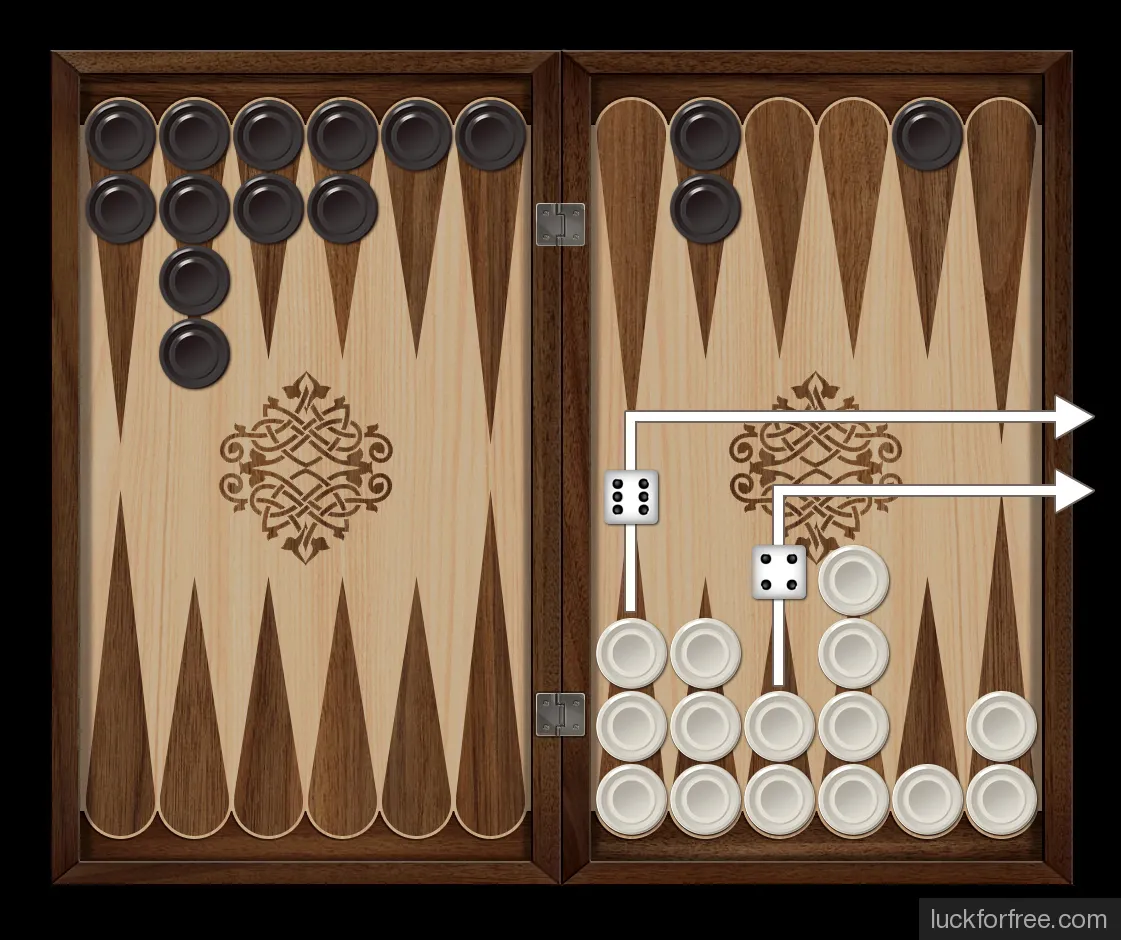
Backgammon is one of the most exciting classic board games. It combines logic, strategy, and an element of luck in perfect balance. Despite its ancient origins, the game is still incredibly popular today. Thanks to the internet, backgammon is now available anytime and anywhere. With just a computer, tablet, or smartphone - you can dive into the familiar and thrilling world of online backgammon.
One reason for backgammon’s popularity is its dynamic pace. Unlike the traditional long nardy, backgammon turns into a fast, action-packed duel. Each dice roll can change the balance of power on the board, so quick reactions and smart strategy are essential.
The simple rules are another reason it attracts so many players: even beginners can quickly pick up the basics of backgammon. But behind this simplicity hides deep tactical play. According to experienced players, winning online backgammon depends not only on luck but also on clever planning. You need to know how to build a strong defense, position your checkers wisely, block your opponent, and create openings for attack. All this fuels the intense competitive spirit - another reason people love it. The Caucasian variant of backgammon introduces special rules, such as restrictions on hitting checkers - you can find more about this in the Rules section.
Online backgammon has built a unique community of enthusiasts. It’s especially popular across the post-Soviet region, where players share a passion for this thrilling variation of the game. On the Fun Games Club website, you can easily find opponents of any skill level and test yourself in fair matches.
Playing with the computer
Sometimes you don’t have a worthy opponent nearby - but that’s no reason to skip a game! You can play backgammon against the computer to sharpen your strategy and prepare for real matches.
Playing with a bot has several benefits:
the opponent never gets tired,
doesn’t get distracted by daily life,
is always ready for a new match,
lets you study the rules at your own pace.
Play at the speed you like. Want to take it slow and analyze moves? Sure. Need a quick warm-up before a tournament? No problem. The bot is a patient and reliable sparring partner.
Playing backgammon with the computer helps you relax and take a break from everyday worries. You can also adjust the game settings: choose between Oin or Mars endings, allow or disallow draws, set the move timer, and even enable breaks.
Playing with real opponents
Backgammon with real players will truly test your skills. Only victories against human opponents prove your mastery, while losses push you to grow and improve.
Playing backgammon with real opponents offers clear advantages:
every player has a unique style, unpredictable moves, and changing tactics - teaching you adaptability;
the competitive spirit: wins feel more rewarding, while losses bring real emotions and valuable lessons;
built-in chat: exchange tips, make friends, plan rematches;
time limits and emotional pressure that train your focus and quick thinking.
No artificial intelligence can replace the thrill of a real challenge. Only a human opponent will push you to your limits and make you play your very best.
Tournaments
Sooner or later, you’ll want to test yourself at the highest level. That’s where online backgammon tournaments come in - where the strongest players meet. Prizes are nice, but prestige and the champion’s title matter much more. Champions are remembered.
Online backgammon tournaments are the ultimate test of skill:
no handicaps or mercy - professionals play to win;
there’s no easy path: to reach the finals, you must give it your all;
every decision is under pressure: tournaments don’t forgive mistakes, and the fast pace keeps you on edge.
Experienced players know winning is about more than just playing well. Want to succeed? Preparation is key. Study the rules, refine your tactics, think several moves ahead, and stay ready for surprises. Calmness, speed, and cold-blooded calculation - these are the weapons of a true champion.
Questions and Answers (FAQ):
How to hit (remove) an opponent’s checker?
A single checker that is not protected by another one on the same point is vulnerable to attack. It can be hit if the opponent lands on it using one of the rolled dice values. A hit checker is removed from the board and must re-enter the game from the beginning.
What is a Kush (Double)?
A Kush is when both dice show the same number. In this case, the player gets a doubled move - meaning they can play that dice value four times: moving 1, 2, 3, or 4 checkers.
Caucasian backgammon - how is it different from standard rules?
In standard backgammon, a player can hit an opponent’s checker in their home board and then cover it with their own. In the Caucasian version, the player cannot hide their checker in this way - once hit, it must re-enter without such protection.
Any game, whether it is a card game or one played on a special board, always involves two components: intellect and an element of luck (each to a greater or lesser extent, depending on the game). Backgammon is no exception. It is an Eastern game for two people played on a special board with 24 points, 15 checkers for each opponent, and two dice. A beginner may think that the outcome depends mostly on luck, on the numbers rolled to make a move, but this is not entirely true. An experienced player who knows the game's strategy (the intellectual component) can quite easily defeat a beginner even with a certain amount of bad luck in the dice rolls.
The rules of Short Backgammon may seem a little confusing because they allow you to hit an opponent's checker (along with moving checkers around the board), after which that checker must be re-entered into the game. However, after reading the rules carefully and playing a few practice games, the rules of Short Backgammon will not cause any difficulties.
Short Backgammon Rules
Two people take part in the game. The player's task is to move their checkers around the entire board and bear them off.
Starting Position
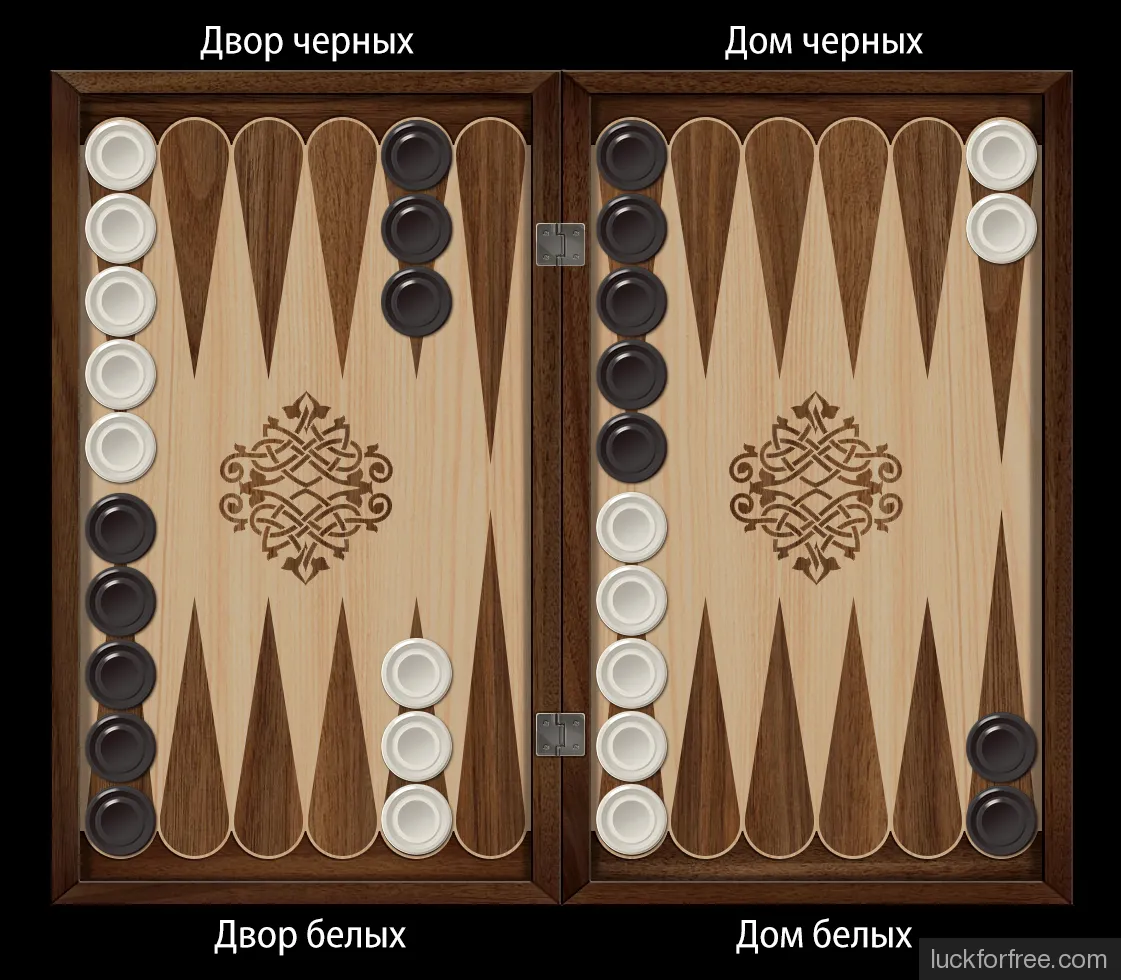
Short Backgammon is played on a board with twenty-four spaces called points. The points are divided into four groups of six points each. These groups are called:
home board (1-6),
outer board (7-12),
opponent's outer board (13-18),
opponent's home board (19-24).
The home board and outer board are separated by a raised strip called the bar.
Each player has 15 checkers: one has black checkers, the other has white checkers.
The game uses a pair of dice.
Everything starts with setting up the backgammon board correctly.
Short Backgammon Setup
When playing online, you do not need to worry about how to set up the backgammon board correctly: the system will do it for you. The starting setup is: point 24 - two checkers, point 13 - five checkers, point 8 - three checkers, point 6 - five checkers. When playing in real life, if you do not know how to set up the board, remember: everything depends on the direction of movement. That is why it is important to understand how to set up Short Backgammon.
The rules of Short Backgammon require strict adherence to the setup: without it, the game cannot start correctly.
In the first game of a series, the right to move first is determined by an opening roll. Each participant rolls one die. The player with the higher number moves first. If the numbers are the same, the roll is repeated until the player who gets the right to move first is determined. The values rolled to determine the order become the first game roll: the winner of the opening roll does not roll again, but makes the first move using the value of their die and the value of the opponent's die.
When playing a series, the order of the first move in subsequent games is determined by the "1st move in series" setting. With the "Loser" option, the player who lost the previous game starts the next game. With the "Alternating" option, the right to move first passes from one player to the other in turn.
Moving Checkers
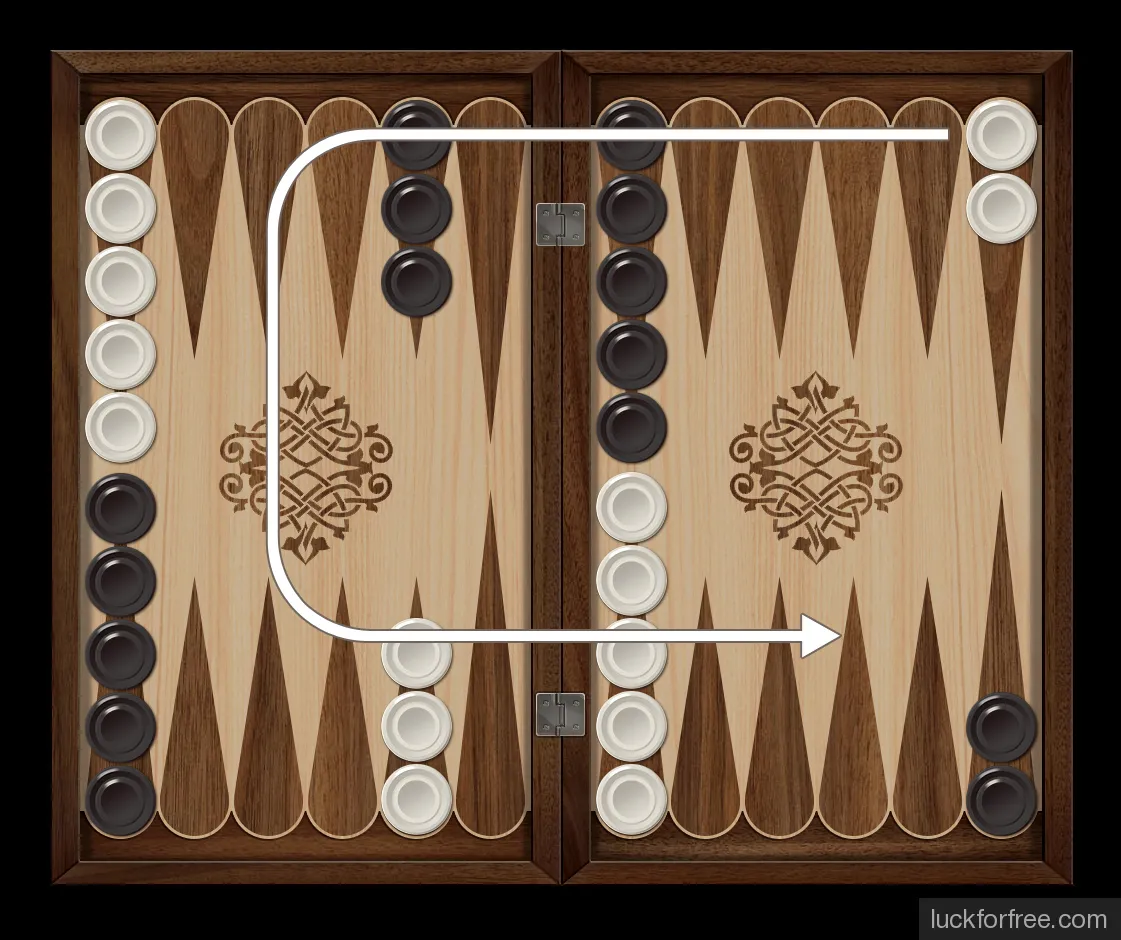
In Short Backgammon, checkers move toward each other. Checkers whose home board is visually located at the bottom (in the image) move counterclockwise, while checkers whose home board is located at the top move clockwise.
Checkers begin their movement from the opponent's home board, enter the opponent's outer board, move into the outer board, then into their own home board, and are subsequently borne off the board.
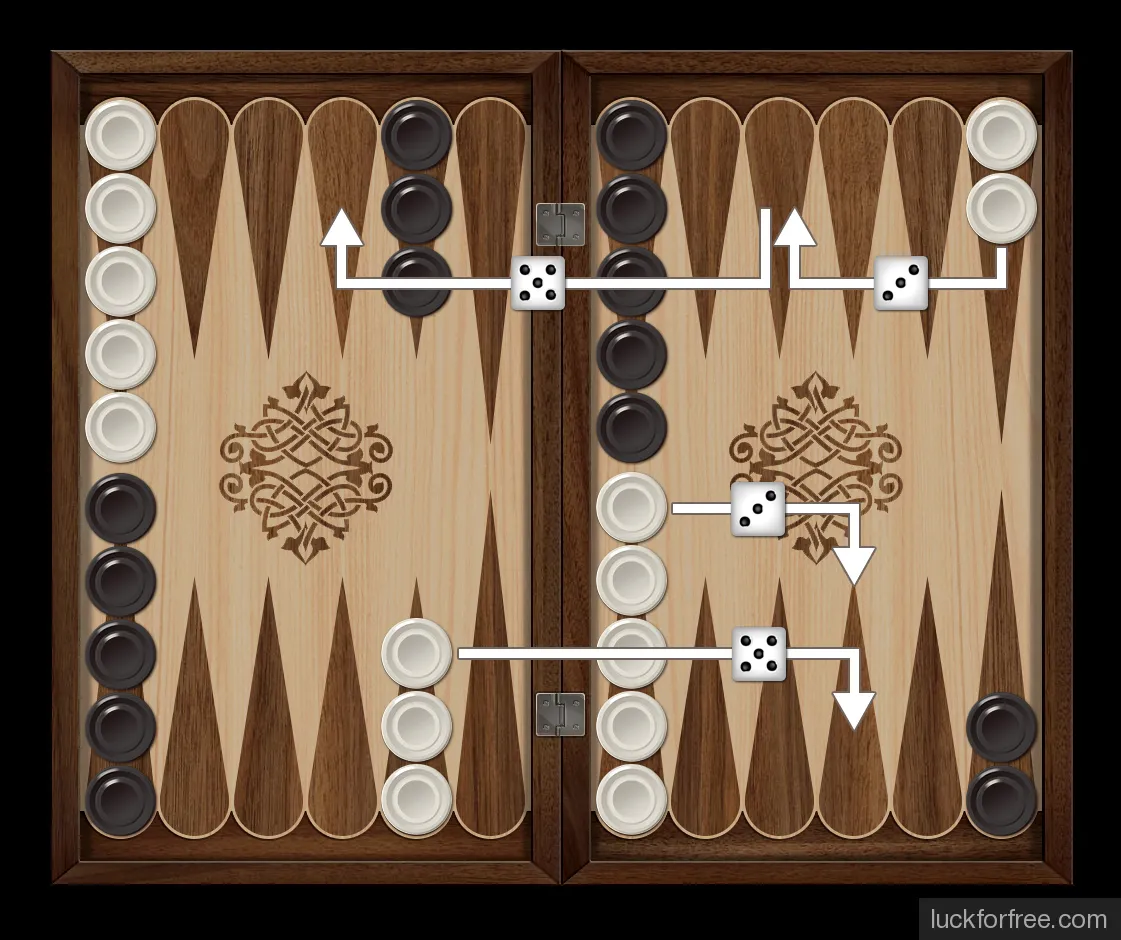
After a roll, the dice show the numbers by which one or two of your checkers must be moved. The values on both dice constitute separate moves.
A checker may be moved to a point that is not occupied by two or more opponent's checkers: to an empty point, to a point with your own checkers, or to a point with one opponent's checker. In the latter case, the opponent's checker is considered hit.
If one checker is moved, the dice values are added together. For example, if 5:3 is rolled, the player may move one checker a total of 8, but only if they can make the intermediate move of 5 or 3.
If two checkers are moved, the value of one die is the number of steps for one checker, and the value of the other die is for the second checker.
Declining to make a move when a move is possible is not allowed.
If it is possible to move one checker but not the other because the point is occupied by two or more opponent's checkers, the player makes one move and the second move is forfeited. If only one checker can be moved by choice, it must be moved by the higher number. For example, if 6:4 is rolled and it is possible to play either 6 or 4, the player must play 6.
If the same value is rolled on both dice, it is called a double and the number of moves is doubled. For example, if 3:3 is rolled, the player makes a move of 3 four times, using one, two, three, or four checkers as they choose.
You may not forfeit a full move if it is possible, even if it is disadvantageous. For example, if 6:4 is rolled, it is possible to move one checker by 6, after which 4 cannot be played, and it is possible to play 6:4 with another checker, the player must play 6:4, that is, use the full move. Once you understand how to play Short Backgammon, you can apply strategy and tactics.
How to Hit and Re-enter a Checker
A point on the board occupied by one opponent's checker is called a "blot".
A "blot" is considered hit if an opponent's checker lands on it. The hit checker is placed on the "bar", which is the center of the board.
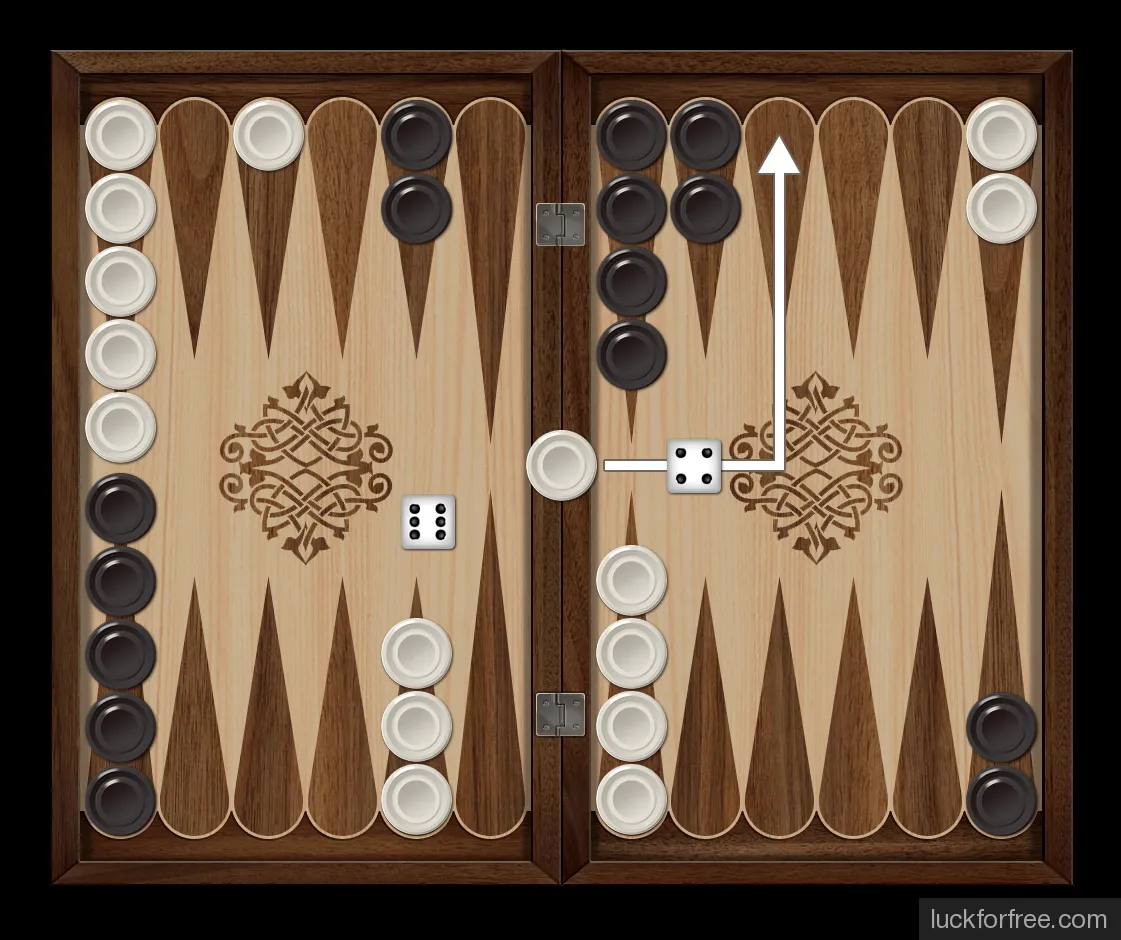
A player who has one or more checkers sent to the bar must first "enter" them into the opponent's home board.
A checker enters the game by moving to the point corresponding to the rolled die value. For example, if a player rolls 2 and 5, they may enter a checker on point 2 or point 5, provided these points are not occupied by two or more opponent's checkers.
If both points corresponding to the rolled dice values are blocked by two or more opponent's checkers, the player forfeits the move. If one of the corresponding points is blocked, the player must use the other rolled value to enter a checker if possible. The remaining value must also be played if a legal move exists after entering the checker from the bar; it is forfeited only if it cannot be used.
Moving checkers on the board is impossible until all checkers have been entered from the bar.
After all checkers have been entered from the bar, the remaining dice value may be used as usual, moving the checker you "entered" or any other checker.
Defense in Short Backgammon
In Short Backgammon, defense is based on creating closed points and reducing the number of single checkers, or "blots", that the opponent can hit.
A closed point is formed by two or more of your own checkers. The opponent cannot end the move of their checker on such a point.
Several consecutive closed points form a block and limit the opponent's movement options. A block of six consecutive closed points is especially strong because an opponent's checker cannot pass through it.
Single checkers on a point are vulnerable: if the opponent lands on such a point, the checker is hit and sent to the bar.
When choosing a defensive position, it is important to consider the opponent's ability to hit a blot and, at the same time, aim to occupy key points in your own home board, making it harder for them to enter their hit checkers from the bar.
Final Stage or How to Bear Off Checkers
You may start bearing off checkers only after the player has moved all 15 of their checkers into their home board.
Bearing off may begin either as a new move, when the checkers were brought into the home board on the previous move and the player rolls the dice and bears off, or as a continuation of a move, when the player brings the 15th checker into their home board with the first move and bears off one of the checkers already there or makes a move within the home board with the second. If a double is rolled, there are even more options because there are four moves.
During the bearing-off stage, all of a player's checkers must be in their home board. If one or more checkers are hit while bearing off, the player must "enter" and bring the checker or checkers back to their home board before continuing to bear off.
The points in the home board are numbered from right to left: the far-right point is 1, followed by 2, 3, 4, 5, and 6.
You may bear off a checker standing on the point corresponding to the die value. If a player rolls 6 and 4, they remove one checker from point 4 and one from point 6.
You do not have to bear checkers off the board only. For strategic reasons, you may also make a regular move. For example, if a player rolls 6 and 4, they remove one checker from point 6 and move another checker from point 6 to point 2, even though there is a checker on point 4 that could be borne off.
If there are no checkers on the point corresponding to the rolled die, the player must make a move according to the rules, moving a checker by the rolled die value.
If there are no options to move a checker, meaning there are no checkers on the point corresponding to or higher than the rolled die value, the player must remove a checker standing on a lower-numbered point. For example, if 4 is rolled and there are no checkers on points 4, 5, and 6, a checker is removed from point 3. If there is none on point 3, it is removed from point 2, and if there is none on point 2, from point 1.
The player must use both numbers rolled and may not decline a move if its result is disadvantageous. For example, checkers stand on points 1, 4, and 6, and the player rolls 5:3. They want to move 3 from point 6 to point 3 in order to bear off the checker from point 4 with 5, effectively playing 4:3. However, the player must play the full move of 5:3 because such a move is available: they move 5 points from point 6 to point 1 and 3 points from point 4 to point 1.
Game Result
There are different rules for bearing off checkers. The game is won by the player who first bears off all their checkers from the board.
If one of the players clicks the "Resign" button, they effectively concede defeat, the game ends, and the opponent receives the winnings.
Short Backgammon differs from other board games in that it does not provide for a draw. A winner and a loser are always clearly determined.
Our project includes a draw option in the pre-game settings: "last roll right". The player with black checkers, who moved second at the start of the game, may make the last roll after the player with white checkers has borne off all their pieces. If they also manage to bear off all their pieces, the game is declared a draw.
Oin, Mars, and Cox
"Oin" is a game position in which the losing player has managed to bear off at least one checker. In this case, they lose one stake.
"Mars" is a game position in which the losing player has not managed to bear off a single checker. They lose a mars, which is two stakes.
"Cox" is a game position in which the losing player has not borne off any checkers and one or more of their checkers remain on the bar or in the opponent's home board. They lose a cox, which is three stakes.
Our project includes the "Oin", "Mars", and "Cox" game-ending options in the pre-game settings:
If the player selects the "Oin" option in the game settings, they lose one stake under any game-ending scenario.
If the player selects the "Mars" option, they lose one stake according to the "Oin" rule, or two stakes according to the "Mars" and "Cox" rules.
If the player selects the "Cox" option, they lose one stake according to the "Oin" rule, two stakes according to the "Mars" rule, or three stakes according to the "Cox" rule.
This rule also applies if one of the players resigns. The number of lost stakes is determined by the selected settings, Oin-Mars-Cox, and the position of the losing player's checkers when the "Resign" button was clicked. For example, if a player selected the "Cox" option in the settings but resigned while their checkers were in a "Mars" position, the base loss is two stakes. If the Doubling Cube is used in the game, this result is additionally multiplied by the current cube value.
"Doubling Cube" Convention
If the "Doubling Cube" option is enabled when creating a table, players can dynamically increase the stake of the current game during play using a special doubling cube with sides 2, 4, 8, 16, 32, and 64, up to the limit selected in the settings. At the start of the game, the cube is in a neutral position and has a value of 1, meaning the base stake; it belongs to neither player.
Doubling offer - on their turn, before rolling the dice, a player who has the right to offer a double may offer the opponent an increase in the current stake of the game by moving the cube to the next numerical value.
Opponent's actions - the opponent must make a decision within the allotted time:
Pass (Drop): Resign. The game ends immediately, and the offering player wins the game at the stake fixed before the offer;
Accept (Take): Agree. The current stake of the game is doubled. Upon the first accepted double, the cube value becomes 2. The cube moves to the accepting player's side, and they become its sole owner.
Cube ownership rule - only the cube owner, the player who accepted the last double, may subsequently offer to raise the stakes again, or "re-double", on their turn before rolling the dice. Once the cube reaches the numerical value selected when creating the table, for example "16", further stake increases become impossible.
Effect on Mars and Cox - if the game ends with a "Mars" or "Cox" win, the base stake for that outcome is multiplied by the Doubling Cube value at the end of the game.
When playing with the Doubling Cube, the player's balance must be sufficient to cover the maximum possible loss. The minimum balance required to join is calculated using the formula: table stake × selected Doubling Cube limit × game-ending coefficient (Oin = 1, Mars = 2, Cox = 3).
If a player resigns with an active Doubling Cube, the loss amount is determined by the position of their checkers according to the selected game-ending option, Oin, Mars, or Cox, after which the current Doubling Cube value is applied. For example, in a "Mars" position with a cube value of 4, the final loss coefficient is 2 × 4.
Caucasian Backgammon - Difference from Standard Rules
Let us consider the features of Caucasian Backgammon. In Caucasian Backgammon, you cannot hit an opponent's checker in your own "home board" and then hide. In other words, a checker that has hit an opponent's checker cannot be moved during the same turn so that it lands on another checker and becomes paired, meaning out of reach of being hit. You may hit a checker and cover the hitting checker with another one. You may hit a checker and move further to an empty point, but not hide. You may hit and bear off a checker if there is no other move. If a double is rolled, for example 1:1, in your home board you may hit-hit-hit-move to an empty point, or use another combination within the rules described above.
Player victory ranking in backgammon for September 2026
Been playin backgammon here for couple months now. Its alright, matches r pretty quick n keeps u on ur toes. Dice can be brutal sometimes lol but thats the game innit. Computer opponent dont cheat which is nice, real players r more fun tho even when they beat me. Chat works good, met some decent folks. Could use better tutorials for beginners but overall not bad way to pass time
Иринушка56
Оценка: 5 из 5
Backgammon
Nice way to pass time, simple and fun.
Кагда Тагда
Оценка: 4 из 5
Backgammon
Been playing backgammon for many years, so I decided to try this online version. The computer opponent is quite decent - doesn't rush you, lets you think things through properly. Interface is simple enough, no fussing around with complicated menus. Played a few matches against real people too, the matching seems fair. Not the fastest site maybe, but it works. Good way to spend an evening without leaving the house.
Govorun
Оценка: 5 из 5
Backgammon
Legit sick game.
Мармеладка
Оценка: 5 из 5
Backgammon
Good for train mind, I play and learn.
База Р
Оценка: 5 из 5
Backgammon
Solid backgammon, neat
April
Оценка: 5 из 5
Backgammon
Backgammon brings back memories. Love it!
Kaas
Оценка: 5 из 5
Backgammon
Never thought backgammon could be so fun.
RoBoT BoT
Оценка: 4 из 5
Backgammon
I never thought I'd get back into backgammon at my age, but here I am. The thrill of playing against real folks or the computer keeps me sharp. The simplicity mixed with strategy is just right for an old-timer like me. A great way to pass the time and keep the mind active!
Беленький 777
Оценка: 4 из 5
Backgammon
Backgammon rocks! It's like chess but faster, keeps my brain sharp and me entertained. Gotta love the thrill of outsmarting real folks and even the computer doesn't give me a break. Perfect for us old-timers!
oMain.isReviewPage = 1;
TRIAL GAMEwithout registration
ПОДПИСКАвступить в Клуб
REQUESTS:
NOW PLAYING:
ONLINE:
FUN
ОПЛАТИТЬ ПОДПИСКУ
PARTNER LINK
?
✔
Получить
Получить
TODAY
WEEK
MONTH
TOP 100
TOP 25
Мы используем cookiesПолитика использования cookies



 Home
Home