Nardy has long gone beyond being just a “board game for old-school fans.” Now it’s a full-fledged online game that not only keeps traditions alive but also fits perfectly into the rhythm of modern life. Everything is simple: all you need is a smartphone, tablet, or laptop - and you can join the game from the office, on a business trip, or at home.
The main advantage is accessibility. Online Nardy brings players from all over the world together, erasing any boundaries. Everyone can choose a comfortable format: classic long matches or quick short ones - depending on schedule and mood. The platform allows you to find opponents of the right level, so there’s always a worthy challenge. This keeps the game exciting and motivates you to grow, improve your strategy, and move forward.
Nardy
Long Nardy online is considered the classic version of the game. It’s especially valued by fans of thoughtful, strategic play. Many prefer to play Nardy because it allows building complex combinations and tactical plans.
Playing classic Nardy is like touching centuries of history. Long Nardy combines luck and skill: each game brings new emotions and keeps you on edge until the very last move. If you want to start playing Nardy right now - our tables are always ready for you.
Online Nardy tournaments help develop professional skills and competitive spirit. For those focused on results and recognition, joining such tournaments is a real chance to prove yourself, strengthen your reputation, and succeed in the world of intellectual games.
Playing Nardy with the computer
Sometimes there’s no way or no desire to play against a real opponent. For those who want to play at their own pace without rush, there’s a computer play mode. It lets you play Nardy against the computer whenever you want, with no pressure. A calm game with AI is a great option: start whenever it’s convenient and make moves without waiting.
Online Nardy with the computer helps you relax and organize your thoughts. Move by move, you enter a focused state where it’s just you, the board, and the game. It’s a great way to stay sharp, train attention and strategic thinking. Play at your own pace, improve, and enjoy the process.
Playing Nardy with real opponents
The brightest emotions and pure excitement come from playing Nardy online with a friend. We invite you to join thrilling matches, discuss tactics, and chat while playing. Communicate and have fun, even if you’re far away!
Get ready to play Nardy with real people and feel the atmosphere of true competition. Watch your opponents’ style, analyze their moves, and adapt your strategy. It’s believed that playing Nardy together strengthens friendships - while also bringing joy and laughter. This is true: the game connects people, sparks emotions, and turns an ordinary evening into lively communication.
If you want to play Nardy online with real players, you can create a table or join an existing one. Opponents of different skill levels are available. This mode is perfect for those who love competition and enjoy every hard-earned victory.
Tournaments
Online Nardy tournaments are a real challenge and celebration for those who love to compete. Taking part gives you a chance to play against top players, test your skills, and feel the thrill of true sports spirit. To win, you’ll need full focus: everything matters - strategy, attention, and the ability to act under time pressure. We recommend reading the tournament rules beforehand so nothing distracts you from the game itself.
Every beginner should practice before entering tournaments. But the battles are so engaging that players look forward to them. The competitive spirit is strong - everyone wants to be first and prove themselves. Join in and you’ll feel how exciting it is to compete. Who knows, maybe you’ll become the next champion.
Questions and Answers (FAQ):
How to place the checkers and make a move in Nardy?
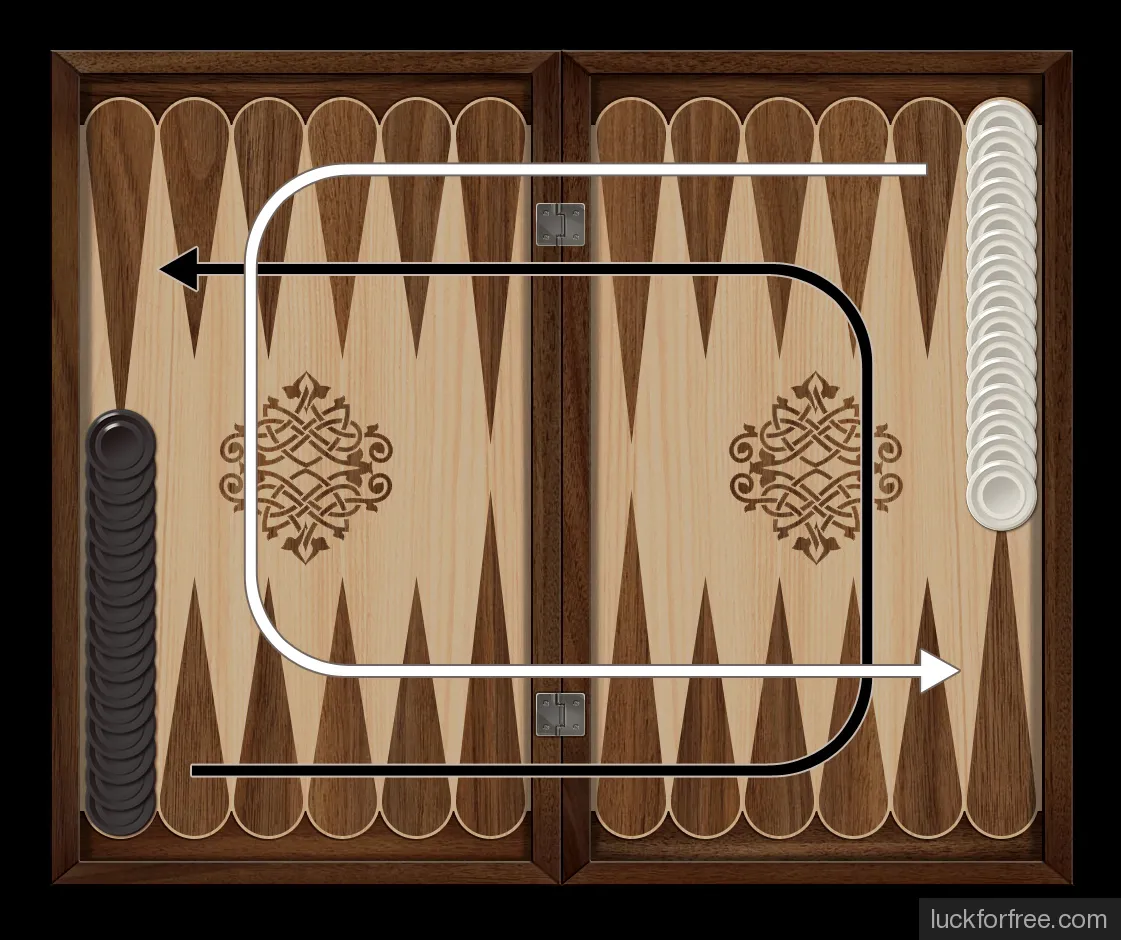
Each player places their checkers at the bottom on the far-left starting point. The checkers move counterclockwise according to the numbers rolled on the dice.
How many checkers can be moved in one turn (one dice throw) in Nardy?
A player can move one checker using both dice values, or move two checkers - one for each dice value. If the dice show doubles, the player can move three or four checkers accordingly.
Can a player skip a turn or use only one of the dice values?

A player must use the full roll (both dice values), even if it’s not advantageous. If no full move is possible but a partial move is, the player must use the higher available dice value or any legal option. Only if no move is possible at all may the player skip their turn.
History and origins of the game
Long backgammon is an ancient Eastern game enjoyed by wise men. The exact place where backgammon was invented is unknown, though Mesopotamia is generally considered its birthplace. The sacred meaning of backgammon is an uncompromising contest in which there must be a winner. The game requires opponents to think strategically and master combinational play. It is impossible to predict which of the two players will win, as random dice rolls can radically change the players' positions throughout the game. Long backgammon is intriguingly interesting and engaging. The rules of long backgammon are so simple that the number of people who enjoy competing in it is enormous. Let's look at how to play long backgammon, as learning to play backgammon will come in handy in any case.
Basic rules of Long Backgammon
Long Backgammon is played by two people on a special board consisting of two equal halves with a total of 24 points. The points are marked with narrow triangles (arrows). Each opponent has 15 checkers (one has light checkers, the other has dark ones), plus a pair of standard dice. The objective of each player is to move their checkers across the entire board and bring them into their own "Home", then be the first to bear them off the board.
Strategies and learning the game
Learning backgammon online is only possible if the rules are written by an experienced player. In addition to knowing how to move and bear off checkers, you need to know the tricks, and there are quite a few of them in the game. Long backgammon secrets help deepen your understanding of the game and improve your chances of winning. Practice allows you to master techniques such as defensive tactics, aggressive strategy, center control, traps and strikes, calculating moves, and efficiently leaving the home board. These skills help you learn to play backgammon, which is especially important when playing against experienced opponents, where every mistake can cost you the game.
How to play backgammon successfully?
To become a successful backgammon player, it is important to study the basic principles of the game, such as defensive tactics, which help keep your checkers safe. In addition, it is useful to master an aggressive strategy aimed at capturing key positions on the board and controlling the center. Both tactics use elements such as traps and strikes, which significantly affect the course of the game. Calculating moves is important during the game, as it allows you to anticipate the next actions and optimize your strategy. While playing, you should learn to analyze your opponent in order to identify and exploit their weaknesses. By completing online backgammon training, you can master all the subtleties of the game, which will help you learn to play backgammon at a higher level.
Starting position
Each player places all 15 of their checkers on the 12th point from the bottom on their left side, relative to their position (counting from right to left).
The right to make the first move in the first game of a series (and, accordingly, the white checkers) is determined as follows: each participant rolls one die, and the player who rolls the higher number moves first. If the values are equal, the roll is repeated. After the first player is determined, they make a separate full roll of two dice and make the first move.
If opponents play a series of two or more games, the right to make the first move in each subsequent game is determined by the "1st move in series" setting. When the "Loser" option is selected, the player who lost the previous game starts the new game. When the "Alternating" option is selected, the right to make the first move passes from one player to the other in turn.
How to make a move
Checkers move counterclockwise. The numbering of the points on the board starts at the bottom right and continues counterclockwise. White's home is at the bottom right, points 1-6; Black's home is at the top left, points 13-18.
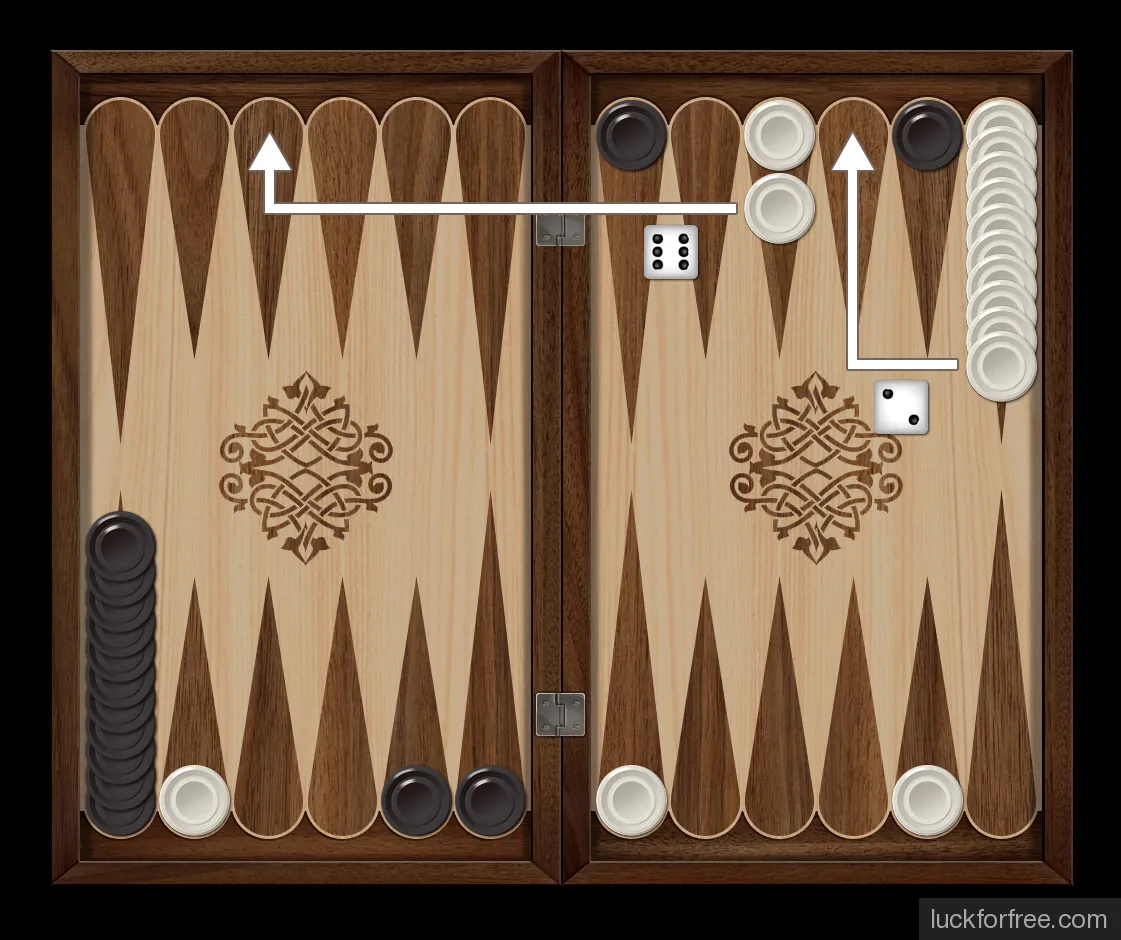
Only one checker may be taken from the starting point. Accordingly, the player makes their first move in the game with one checker: by the total value of both dice (if they show different values) or by making four moves (if a double is rolled), according to the value of one die. On subsequent moves, two checkers may be used, for example, one from the starting point and the other from the playing field, or both moves may be made with a checker or checkers from the playing field.
An exception applies when White rolls doubles of 3:3, 4:4, or 6:6 on the first move. In that case, White may remove two checkers from the starting point, as it is impossible to make a full move with one checker in this situation because of the opponent's checkers in the starting position.
The same rule applies to Black, but with an exception:
if White's first roll is 5-5 and Black's subsequent roll is 4-4, Black removes one checker from the starting point and makes only one move.
A point occupied by at least one opponent's checker is considered occupied, and you cannot place your checker on it. Such points are considered closed, unlike open points that may be entered.
You may move as many points as shown on each die. For example: one checker may move by the total value of both dice, with each value being a separate move; two checkers may move according to the corresponding value of each die.
If doubles are rolled, the number of moves is doubled. That is, one checker may make four moves according to the value of one die, or the moves may be "divided" among any number of checkers, for example, one move each for four checkers.
You may not skip moves.
If it is possible to make a move using only one of the values on the two dice, the player makes that possible move and the other value is forfeited. If only one checker can be moved and there is a choice, it must be moved by the higher value. For example, if 6:4 is rolled and it is possible to play either 6 or 4, the player must play 6.
If the rolled dice values do not allow a move to be made because the positions are occupied by the opponent's checkers, the player skips the turn.
You may not skip a full move, even if it is disadvantageous. For example, 5:2 is rolled. It is possible to move one checker by 5, after which it is impossible to play 2, and it is also possible to play 5:2 with another checker. The player must play 5:2, even if the first option is more advantageous.
It is prohibited to build a "block" of six or more checkers if there is no opponent's checker ahead of the block being built. The position of the opponent's checker, whether in the home board or outside it, does not matter.
Bearing off checkers
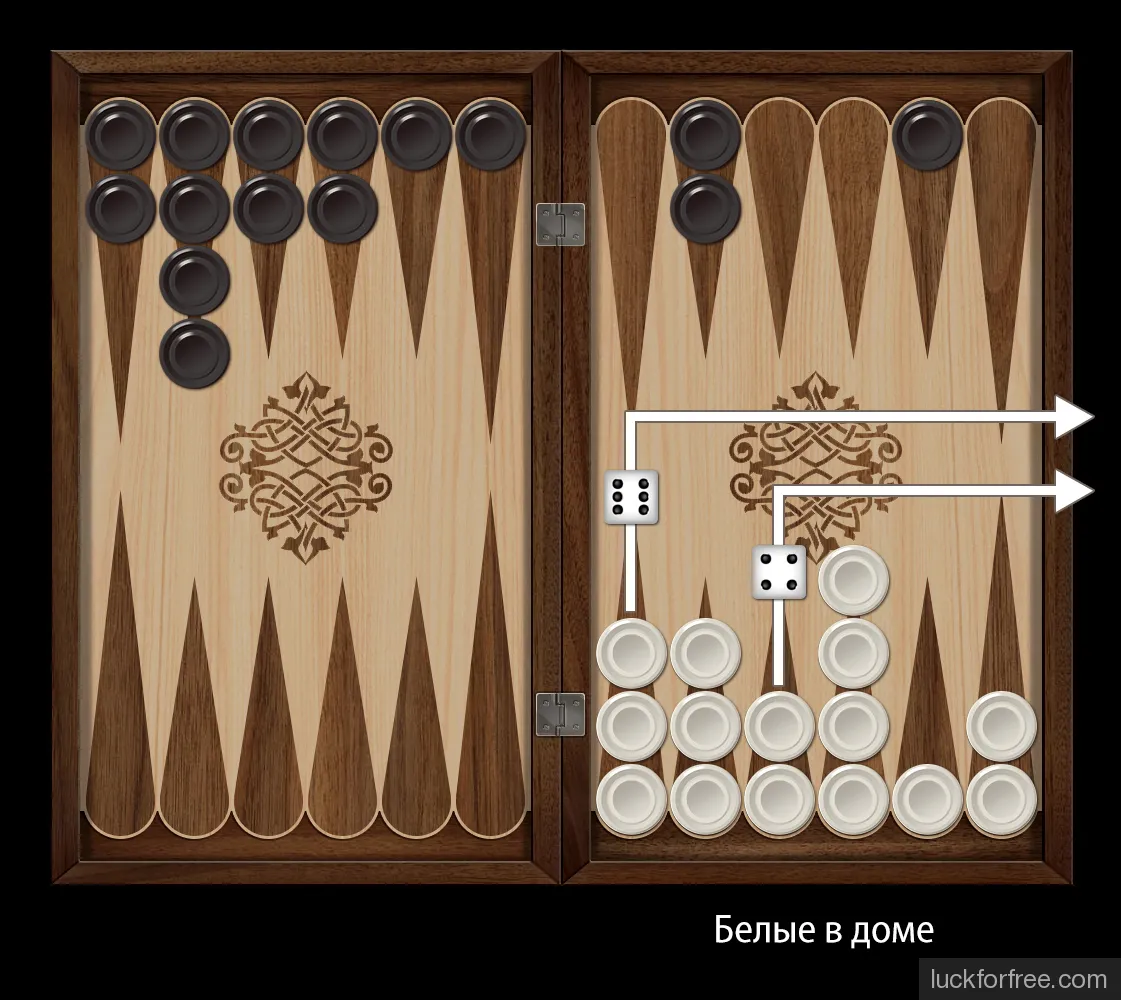
After all 15 checkers have entered the "home", they may be removed from the board. This is called bearing off checkers. For example, if the dice values are 6 and 4, the player bears off one checker from the 4th point from the right and one from the 6th point from the right.
If there are no checkers on the points matching the rolled dice values, the player must move the checkers according to the general rules. For example: the dice show 6:5, and the player has no checkers on the 5th point; they bear off one checker using the six from the 6th point, and use the five to move a checker from the 6th point to the 1st.
If the player cannot move or bear off a checker because there are no such options, they remove from the board a checker from the leftmost point where checkers are present. For example, if the dice show 3:4 and checkers remain only on the 1st and 2nd points, the player must first remove from the board the checkers from the 2nd point, then from the 1st.
The player must use both dice values rolled and cannot refuse a move if its result is disadvantageous. For example, two checkers are on points 4 and 6, and the dice show 5:3. The player wants to move 3 from point 6 to point 3 in order to bear off the checker from point 4 with a 5, effectively playing 4:3. The player must make the full 5:3 move because such a move is available: from point 6, move 5 to point 1, and from point 4, move 3 to point 1.
Game result
The game ends when one participant has completely removed their checkers from the points on the board. This player is considered the winner.
If one of the players clicks the "Surrender" button, they effectively admit defeat, the game ends, and the opponent receives the winnings.
Long Backgammon has two possible game outcomes: "Oin" and "Mars".
"Oin" is a game position in which the losing player has borne off at least one checker, in which case they lose one stake.
"Mars" is a game position in which the losing player has not borne off a single checker, in which case they lose two stakes.
This rule also applies when one of the players clicks the "Surrender" button. In this case, the player loses a stake according to the position of the checkers on the board, Mars or Oin, and the corresponding preset settings. For example, a backgammon player surrendered with the checkers in a "Mars" position, but the "Oin" option was selected in the preset settings, so the loss is one stake, Oin.
In modern competitive backgammon, when tournaments are held, a game may end in a draw. This is the "last roll right", when the player with Black may make the final dice roll because they moved second in the game after the player with White has borne off all their checkers. If Black also manages to bear off all their checkers as a result, a draw is recorded. In the fungamesclub.com gaming club, this option is available in the game's preset settings.
Отзывы
Оценка пользователей 4.8 из 5 (всего 25 голосов)
Осталось символов:
Dreiky
Оценка: 4 из 5
Nardy
I play long nardy at lunch. Computer bot is good, but waiting move is little slow.
S-Top
Оценка: 4 из 5
Nardy
Been playing this nardy thing for a couple weeks now. Its nice to sit down with a cup of tea and play against the computer when the grandkids are visiting - keeps the mind sharp you know. The interface is straightforward enough, not like those complicated newfangled programs. Sometimes I play with real people to, though they move too fast for my taste. Still its a decent way to pass the evening without leaving the house.
Gastoler
Оценка: 5 из 5
Nardy
Nardy's a solid game, good for old blokes like me. No regsitration needed, which is a bonus.
Мартина Навратилова
Оценка: 5 из 5
Nardy
fun, but a bit laggy
nekrasova
Оценка: 5 из 5
Nardy
Nardy is fun! I play every day. Easy to start and keeps me thinking.
Маринушка-88
Оценка: 5 из 5
Nardy
Love Nardy! Keeps me sharp.
yuh456
Оценка: 4 из 5
Nardy
At my age, finding games that challenge the mind and offer a bit of nostalgia ain't easy. But Nardy does it perfectly. Love how I can play with folks worldwide or just chill with the computer. Keeps the ol' brain sharp!
Давыдович
Оценка: 4 из 5
Nardy
Been diving into Nardy lately and it's a blast! Love how I can just jump in anytime from my phone or laptop. Whether I'm chillin' at home or on a break at work, it's super convenient. The thrill of playing with real folks is unmatched, but when I just wanna relax, going against the computer is solid too. It's kept me sharp, and honestly, I've learned a ton of new strategies. This game's a keeper!
Минисо
Оценка: 4 из 5
Nardy
Playing Nardy here is a blast! As someone who's seen a lot of games come and go, this one keeps me on my toes. I enjoy the mix of luck and strategy, especially against real folks. Makes the brain work and it's fun to see how different people play. Great for a cozy evening in!
Игрок643042705
Оценка: 5 из 5
Nardy
Super
oMain.isReviewPage = 1;
TRIAL GAMEwithout registration
ПОДПИСКАвступить в Клуб
REQUESTS:
NOW PLAYING:
ONLINE:
FUN
ОПЛАТИТЬ ПОДПИСКУ
PARTNER LINK
?
✔
Получить
Получить
TODAY
WEEK
MONTH
TOP 100
TOP 25
Мы используем cookiesПолитика использования cookies